Prologue: The Whisper That Crossed the Ocean
It begins, as all revolutions do, in silence.
No billboards. No noise. No promises.
Just a vision — soft, defiant, and dressed in black.
When Rei Kawakubo sent her first garments from Tokyo to America, she wasn’t trying to sell a dream.
She was trying to destroy one — the glossy illusion of perfection that had wrapped itself around fashion’s fragile heart.
In her world, beauty was not what you see — it was what you feel when you stop trying to define it.
And when that world touched the United States, fashion changed forever.
I. The Arrival
New York, 1981.
A city trembling between chaos and creation.
Rei arrives not with diamonds or couture, but with void — shapes unrecognizable, fabrics undone, silhouettes that disobey.
She does not present.
She provokes.
The critics called it “ugly.”
The thinkers called it “truth.”
The artists called it “freedom.”
What America didn’t know then was that Rei wasn’t designing clothes.
She was designing language.
“Creation comes from conflict,” she once said.
And in that conflict, she found a home.
II. A Philosophy, Not a Brand
Comme des Garcons never behaved like a brand.
It breathed like an idea.
In Rei’s universe, the human form wasn’t something to flatter — it was something to question.
Fabric wasn’t decoration — it was conversation.
Each cut, each wrinkle, each void was intentional.
To wear her work was to accept imperfection as power.
While America celebrated surface, Rei studied silence.
While others designed outfits, she designed thoughts.
Her vision, raw and mathematical, met a country obsessed with visibility —
and showed it the art of invisibility.
III. The SoHo Experiment
The first Comme des Garcons store in New York wasn’t a boutique.
It was an idea in architecture.
White walls.
Stark lighting.
No music. No mirrors. No sales pitch.
You didn’t enter to shop. You entered to think.
Fashion students wandered the aisles like pilgrims.
Designers stood quietly, taking notes.
Celebrities whispered her name like a secret code — something understood, not spoken.
The store didn’t sell luxury; it sold permission — to feel uncomfortable, to question what fashion could mean.
IV. The Red Heart That Smiled Back
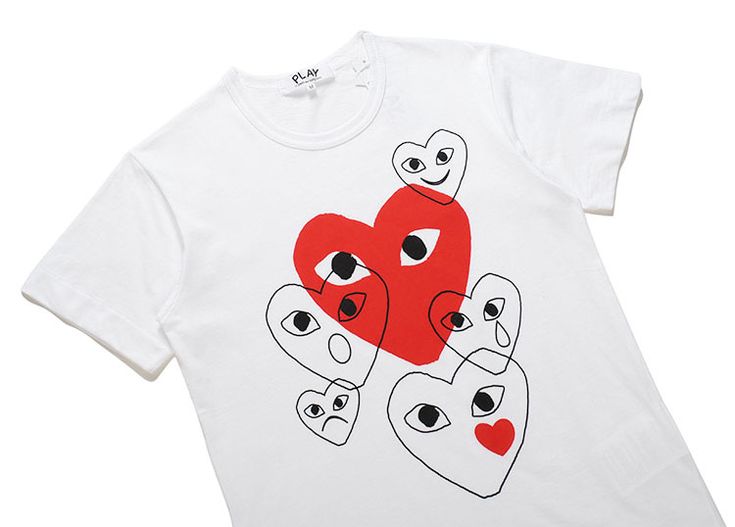
Then came the heart.
A flash of red.
Two imperfect eyes.
Comme des Garcons PLAY was born — a softer, warmer fragment of Rei’s mind.
Cotton tees, striped sweaters, clean sneakers.
Accessible, yet still intellectual.
The heart by Polish artist Filip Pagowski wasn’t decoration — it was irony.
It looked playful, but behind that smile was thought.
In a country obsessed with branding, PLAY became a symbol of quiet intelligence —
a way to say “I belong to the idea, not the trend.”
In New York, you’d see it on skaters and stylists alike.
In L.A., it appeared on directors, musicians, writers.
Everywhere it went, it whispered the same thing:
Style can think.
V. Collaborations as Conversations
Rei never chased collaborations.
She invited dialogue.
- 🖤 Comme des Garcons x Nike → performance as philosophy
- ⚡ Comme des Garcons x Supreme → rebellion with restraint
- ❤️ Comme des Garcons x Converse PLAY → heritage with humor
Each partnership became a small manifesto.
Each design, a moment of co-existence.
Rei didn’t dilute her identity — she taught others how to elevate theirs.
Her American collaborators didn’t just borrow her aesthetic; they borrowed her way of thinking.
VI. The House of Contradictions
America has always loved contradiction.
So has Rei Kawakubo.
Her garments — asymmetrical yet balanced, fragile yet armored — felt like portraits of the American condition.
They mirrored the duality of freedom and chaos, order and rebellion.
In a world chasing likes and labels, Comme des Garcons offered a deeper pleasure: the luxury of not explaining yourself.
It was fashion for thinkers.
Clothing for souls that resist simplicity.
VII. Dover Street Market: The Revolution Within Walls
New York welcomes Dover Street Market — Rei’s physical manifesto.
It isn’t a shop.
It’s a theatre of the mind.
Every brand inside it — from Prada to Undercover — behaves differently here.
The lighting hums like meditation. The mannequins seem alive.
Nothing is fixed; everything is in motion.
DSM redefines retail as experience, commerce as art, and consumption as reflection.
To walk through it is to walk through Rei’s imagination —
one that stretches from Tokyo’s narrow alleys to New York’s restless skyline.
VIII. The Genderless Generation
Long before “genderless fashion” filled American headlines, Rei had already erased the binary.
Her collections blurred body and meaning.
Her models moved between identities with grace, power, stillness.
When she cut fabric, she wasn’t cutting for a man or a woman —
she was cutting for a human being.
In doing so, she gave a generation of Americans a new language —
a way to dress beyond definition.
“My clothes don’t define gender,” she said. “They define emotion.”
That single idea reshaped the future of style.
IX. The Street Learns to Think
What began as intellectual rebellion soon became street instinct.
The Comme philosophy — once whispered in galleries — now danced on city corners.
Skaters wore deconstructed shirts.
Rappers referenced Rei in lyrics.
Design students painted the heart logo on thrifted jackets.
Comme des Garcons didn’t adapt to American streetwear.
Streetwear rose up to meet it.
It became a code between those who understood —
a sign of rebellion that didn’t need to shout.
X. The Legacy That Refuses to Fade
Today, Comme des Garcons is not a brand you follow — it’s a belief you inherit.
You see it in:
- the restraint of The Row,
- the distortion of Rick Owens,
- the conceptual freedom of Maison Margiela,
- the intellect of Fear of God.
Every designer who bends reality owes a quiet debt to Rei.
Because she proved that you don’t have to be loud to be radical.
You don’t have to be beautiful to be loved.
You don’t have to be understood to matter.
XI. The American Mirror
The story of Comme des Garcons in the USA is not a story of invasion — it’s a story of reflection.
America gave Rei its streets, its energy, its contradictions.
Rei gave America a mirror.
A mirror that asked:
What is beauty?
What is gender?
What is fashion when stripped of fame?
And even now, decades later, those questions echo in every black garment, every stitched asymmetry, every blank space left on purpose.
✒️ Epilogue: The Art of Unknowing
Rei Kawakubo once said, “I work within the space between creation and destruction.”
That space — quiet, fragile, infinite — is where Comme des Garcons still lives.
In America, her influence doesn’t scream.
It breathes.
In the shadows of SoHo stores, in the stitched hearts on t-shirts, in the calm defiance of new designers — her philosophy endures:
to create something honest enough to unsettle.
And perhaps that is the true legacy of Comme des Garcons in the USA —
a reminder that fashion, like thought, only evolves when it dares to unlearn.