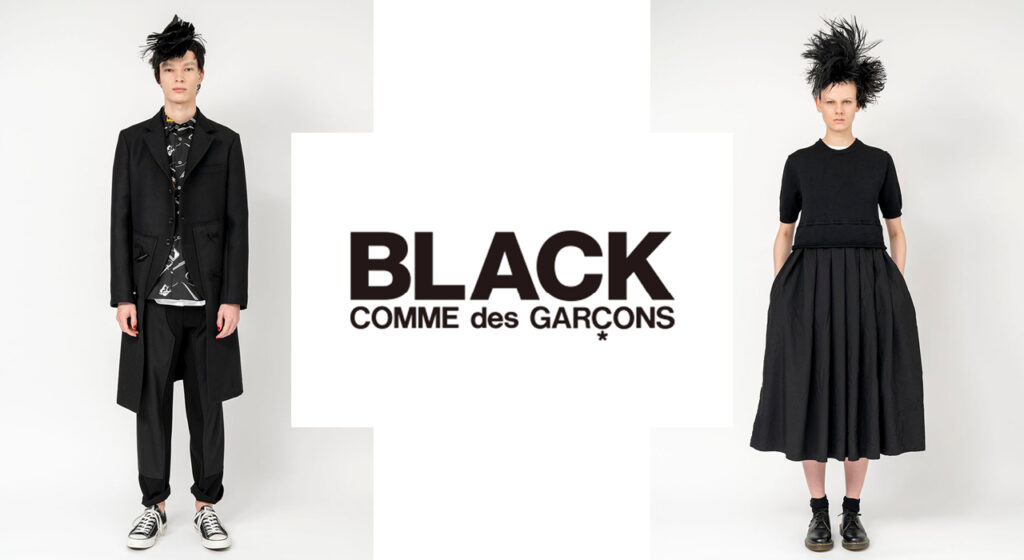
❖ INTRODUCTION — A BRAND THAT REWROTE BEAUTY
There are brands that follow trends.
And then there is Comme des Garçons, which creates entire new worlds.
Born in Tokyo, raised in rebellion, and redefined in Paris, Comme des Garçons is not merely a fashion house — it is an idea factory, a cultural philosophy, a statement that style can exist beyond beauty.
At its core stands Rei Kawakubo — mysterious, minimal, and magnetic.
A designer who never studied fashion, yet taught the world how to see it differently.
“Fashion should be a tool to express something new, something you’ve never felt before,” she said.
From a small Tokyo studio to the grand stages of Paris, her journey is one of innovation, courage, and controlled chaos — a story that proves that true creativity doesn’t follow rules.
It writes them.
🜂 CHAPTER I — TOKYO: THE BEGINNING OF DISORDER
The year: 1969.
The place: Tokyo.
A city glowing with post-war prosperity — and the hum of conformity.
Rei Kawakubo, a graduate in Fine Arts and Literature from Keio University, was working as a stylist. But what she saw around her — the commercial prettiness of 1960s fashion — felt hollow.
So she started something radical.
In 1969, she began designing under the name Comme des Garçons — “like boys.”
A French title chosen by a Japanese woman.
A contradiction by design.
By 1973, her label was official.
By the late ’70s, it was a phenomenon.
Tokyo’s youth — disenchanted with consumerism — found truth in her darkness. Her early collections were sparse, structured, and intellectual:
- Black wool coats with uneven hems
- Asymmetric knits
- Raw edges that spoke louder than decoration
She was designing not for adornment, but for identity.
“Clothing can express what words cannot,” she once told a journalist.
Her small Aoyama studio became the nucleus of a new kind of fashion — silent rebellion sewn in black thread.
🜃 CHAPTER II — PARIS 1981: THE EXPLOSION OF THE UNEXPECTED
When Rei Kawakubo brought Comme des Garçons to Paris Fashion Week in 1981, no one was prepared.
The show opened with silence.
Then came the shock.
Models in all black — shapeless, deconstructed, unfinished. Their bodies wrapped, distorted, armored. It was raw, emotional, and terrifyingly beautiful.
Fashion journalists didn’t know what to call it.
Some labeled it “Hiroshima chic.”
Others saw the birth of the avant-garde.
But Kawakubo didn’t care. She wasn’t there to please; she was there to provoke.
This was not about femininity. It was about freedom.
Alongside Yohji Yamamoto and Issey Miyake, she led what became known as the Japanese Invasion — redefining Paris fashion with asymmetry, imperfection, and intellectual rigor.
Her philosophy was simple:
“Creation comes from destruction.”
Every thread became a protest.
Every collection — a manifesto.
🜄 CHAPTER III — THE DECADE OF DECONSTRUCTION (1982–1989)
The 1980s made Comme des Garçons a global symbol of rebellion.
Where others polished, she tore.
Where others fitted, she distorted.
Where others beautified, she challenged.
Her clothes felt alive — rough, emotional, honest.
Her models looked androgynous, unbothered, beautifully alien.
Signature 1980s moments:
| Year | Collection | Concept |
|---|---|---|
| 1982 | Destroy | The elegance of imperfection; clothes that looked torn by time. |
| 1983 | Body Meets Dress, Dress Meets Body | Padded bulges challenging the idealized female form. |
| 1986 | Comme des Garçons Homme Plus | Menswear that blurred the lines between toughness and tenderness. |
Each show was more than a runway — it was a philosophical performance.
And slowly, the world began to understand that Rei Kawakubo wasn’t anti-fashion.
She was beyond fashion.
🜁 CHAPTER IV — THE 1990s: EXPANSION, INNOVATION, AND EMPIRE
The 1990s were years of growth — but growth on her terms.
Kawakubo created a universe of sub-labels, each a unique experiment:
- Tricot Comme des Garçons — for the everyday avant-garde.
- Comme des Garçons Homme Deux — formalwear meets emotional minimalism.
- Comme des Garçons Parfum (1992) — scents that smelled of tar, earth, and electricity, redefining what perfume could be.
- Junya Watanabe Comme des Garçons (1994) — her protégé, engineering new forms from her legacy.
Her perfume launch in 1992 was a quiet revolution. “Anti-perfume,” she called it — abstract, genderless, and intellectual.
She didn’t sell fragrance; she sold experience.
Through the 1990s, Rei’s collections became even more architectural — shaped, molded, sculpted.
Her runways became performance art. One season explored deformity, another the void of identity. The critics didn’t always understand — but she never designed for them.
“I don’t care about what’s happening. I only care about what should happen.”
🜆 CHAPTER V — THE HEART WITH EYES (2000–2010)
The new millennium brought a softer rebellion.
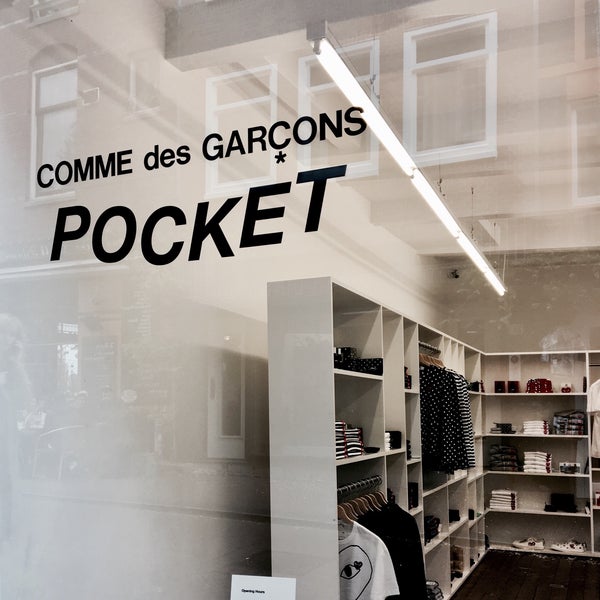
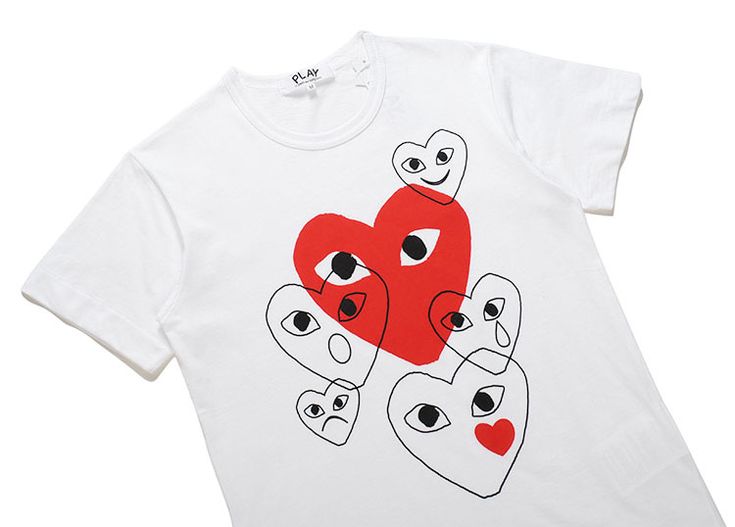
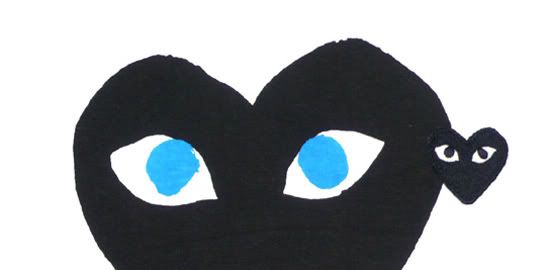
In 2002, a red heart with eyes appeared — the symbol of Comme des Garçons PLAY.
Created by artist Filip Pagowski, the logo was playful yet profound — a wink from the avant-garde to the mainstream.
PLAY became a bridge between Kawakubo’s intellectual roots and youth culture, a conversation between streetwear and art.
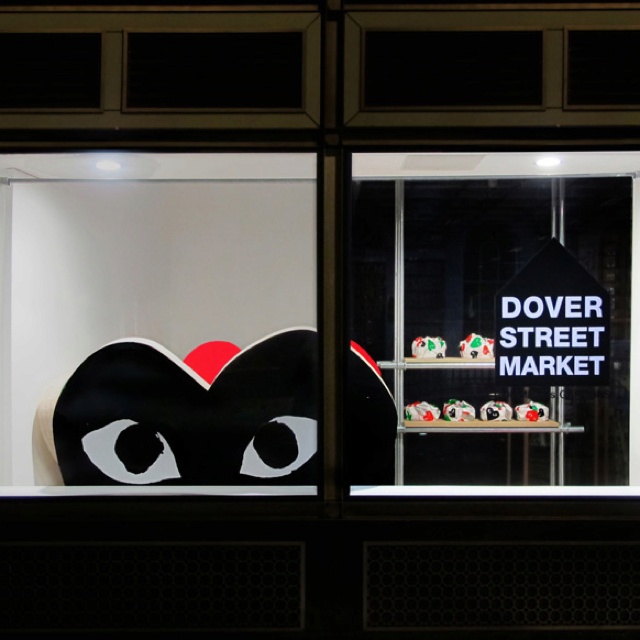
At the same time, she introduced one of her boldest ventures: Dover Street Market (DSM) in London (2004).
DSM wasn’t just a store; it was a living installation.
Concrete pillars, industrial design, rotating installations — every floor an artistic collaboration.
The idea spread worldwide — to Tokyo, New York, Beijing, Los Angeles, Paris — each location curated by Rei herself.
Collaborations became part of the Comme des Garçons language:
- Nike → Conceptual sportwear.
- Converse → Global cult sneakers.
- Louis Vuitton → High-fashion contradiction.
- H&M → Luxury meets accessibility.
Through them all, she retained her independence.
Comme des Garçons became a paradox: both niche and universal.
“Collaboration is not compromise,” she insisted.
“It is conversation.”
🜇 CHAPTER VI — ART AS FASHION (2010–2019)
By the 2010s, Rei Kawakubo had transcended design.
Her shows were no longer fashion presentations — they were art installations in motion.
Each collection felt like a statement:
- 2012: “White Drama” — exploring birth, death, and ritual in layers of cocooned white fabric.
- 2014: “Not Making Clothes” — garments that defied wearability, pure abstraction.
- 2017: “The Art of the In-Between” — The Metropolitan Museum of Art dedicated an entire exhibition to her — only the second living designer ever honored after Yves Saint Laurent.
The Met exhibit featured 140 pieces across decades — works that blurred the line between creation and destruction, order and chaos.
Kawakubo’s genius was not in making clothes for people — but in making clothes about people.
She turned the body into metaphor.
She turned fashion into philosophy.
🜊 CHAPTER VII — THE NEW AGE: 2020s AND THE DIGITAL VOID
The world changed.
So did Comme des Garçons — subtly, silently.
While brands rushed toward digitalization, Kawakubo continued her analog rebellion.
Recent collections reflect her meditation on technology and isolation:
| Year | Collection | Concept |
|---|---|---|
| 2020 | Neo Future | Human emotion in a mechanized world. |
| 2021 | Metal Outlaw | Armor as expression — resistance through fashion. |
| 2023 | Black Rose | Strength through vulnerability. |
| 2024 | In-Between Worlds | Beauty found in contradiction. |
Meanwhile, Comme des Garçons Homme Plus continues to reinterpret masculinity for the digital age — exploring identity through structure, texture, and silhouette.
Rei Kawakubo’s protégés — Junya Watanabe, Kei Ninomiya, and Fumito Ganryu — carry her code into the next generation.
Her empire remains a paradox of growth and purity — proof that staying different is the ultimate success.
🜏 CHAPTER VIII — BETWEEN JAPAN AND FRANCE
Comme des Garçons exists between two worlds — between restraint and drama, void and volume, Zen and chaos.
| Aspect | Japan | France |
|---|---|---|
| Aesthetic | Wabi-sabi — beauty in imperfection | Haute couture — beauty in precision |
| Emotion | Serenity | Passion |
| Method | Conceptual minimalism | Artistic expression |
| Outcome | Comme des Garçons — Harmony through opposition |
From Tokyo’s hidden alleys to Paris’s catwalks, Kawakubo became a cultural translator — transforming contradictions into couture.
She built a bridge, not between countries, but between ideas.
🜕 CHAPTER IX — THE WOMAN BEHIND THE EMPIRE
Rei Kawakubo is as enigmatic as her designs.
She doesn’t give interviews easily.
She rarely smiles for cameras.
She avoids self-promotion.
In a world obsessed with identity, she remains undefined.
Her Tokyo studio is famously quiet — no music, no clutter, no distractions. Just fabric, pins, and imagination.
Her partner and business collaborator, Adrian Joffe, describes her as “a philosopher disguised as a designer.”
“I create when I feel there is something missing in the world,” she says.
That void — the in-between — is where Comme des Garçons lives.
🜓 CHAPTER X — THE LEGACY: BEYOND FASHION
Rei Kawakubo has shaped the future of design.
Her influence can be felt across generations and disciplines.
Designers like Martin Margiela, Rick Owens, Demna Gvasalia, and Virgil Abloh all carry fragments of her spirit — the courage to question, to deform, to rethink.
Even the concept of genderless fashion traces back to her work in the 1980s.
Her ideas anticipated the cultural conversations of today — long before the world caught up.
Kawakubo made it possible for fashion to be serious, emotional, intellectual.
She taught that beauty can emerge from destruction, and that perfection can be deeply boring.
❖ CONCLUSION — THE ART OF BEING IN-BETWEEN
More than 50 years later, Comme des Garçons remains undefinable.
It is Japanese and French, minimal and maximal, intellectual and emotional — everything and nothing at once.
Rei Kawakubo doesn’t follow trends. She creates languages.
Her brand doesn’t sell fashion. It sells freedom.
“The future is in the void,” she once said.
From Tokyo’s chaos to Paris’s poise, from black cloth to conceptual light, Comme des Garçons continues to evolve — not by changing itself, but by changing how we see.
Because Rei Kawakubo’s greatest creation was never a dress.
It was the idea that fashion could be thought.